


A Maryland medical card gives you legal access to medical cannabis. It covers conditions like chronic pain, anxiety, PTSD, and many others. The process is not the same as in most states. Maryland has you register with the state before you see a provider. This reverse order confuses many applicants. You need to know which conditions qualify and what the process costs. You also need to know how medical cannabis differs from the adult-use program that now runs alongside it.
This guide walks you through each step. You will check your eligibility, gather your documents, and finish your state registration. Then you will get certified by a provider and use your card at dispensaries. You’ll learn the timeline for each step and the fees you’ll pay. You’ll also see how Maryland’s medical program protects you in ways the recreational market doesn’t.
Maryland Medical Card: Who This Guide Is For
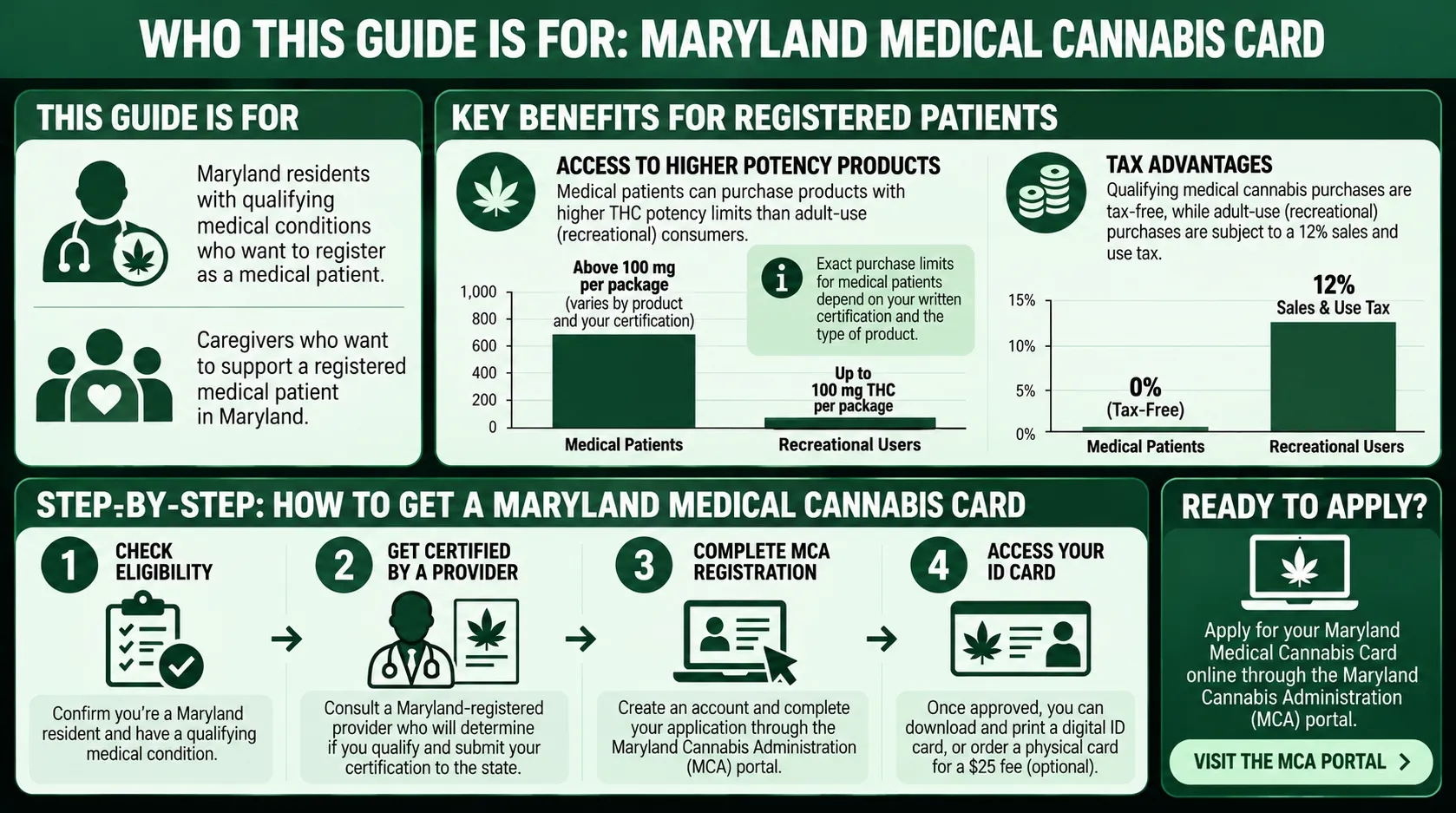
This guide helps Maryland residents who want to learn about medical cannabis as a treatment for chronic health conditions. You may have tried standard treatments without enough relief. You may wonder if cannabis could help.
Maryland Residents Exploring Medical Cannabis
The guide also explains how Maryland’s medical and adult-use programs differ. Medical patients get access to higher potency products. They may also get tax savings that recreational users don’t get.
First-time applicants will find clear, step-by-step help with the Maryland Cannabis Administration registration process. If you’re ready to start, you can apply for your Maryland medical cannabis card online through telehealth services that make the whole process easier.
Parents and Caregivers of Minors
Parents and guardians who are looking into medical cannabis for a minor with a qualifying condition will find useful information here. Maryland lets minors join the medical cannabis program with extra safeguards, including a registered caregiver who is a parent or legal guardian.
Caregivers need to know their role in the registration process. They also need to know their duties for getting and giving medical cannabis. The guide covers the rules for caregiver registration and how the system links caregiver and patient accounts.
Who Qualifies for a Maryland Medical Cannabis Card
How Maryland Determines Medical Eligibility
Maryland lists specific qualifying conditions, including severe or chronic pain, severe nausea, seizures, severe or persistent muscle spasms, glaucoma, PTSD, and other conditions that meet the state’s medical requirements. Providers can also certify another severe chronic condition when other treatments have been ineffective.
This differs from states with strict qualifying conditions by state. It gives Maryland doctors room to help patients who may benefit from cannabis therapy. The bond between provider and patient, along with clinical judgment, forms the base of Maryland’s medical cannabis program.
Providers often certify chronic pain, anxiety disorders, PTSD, nausea, seizure disorders, and conditions that cause severe or lasting symptoms. Certification is not limited to these, however.
The Role of Your Healthcare Provider
Your provider looks at your medical history, current symptoms, past treatments, and general health. Then they decide if medical cannabis fits your situation. At LeafyRx, we connect patients with MCA-registered providers who know the certification process.
You must be a Maryland resident with valid proof of residency. See the Maryland Cannabis Administration patient guide for current registration requirements. Your provider will review this paperwork along with your medical records during the visit.
Understanding the Maryland Application Sequence
The Maryland Cannabis Administration process guide explains each step. Maryland’s medical cannabis process follows a set order that differs from most other states. You register with the state before you visit a provider, not after. Learn how to get your card before you start.
Step 1: Register as an MCA Patient
Start by creating an account on the Maryland Cannabis Administration patient portal. You’ll send in your proof of residency and basic information. This registration is currently free.
The MCA reviews your application within 5-7 business days. Many applicants who use services like LeafyRx find the online portal easy. Still, having your documents ready beforehand prevents delays.
Step 2: Receive Your Patient ID
Once you’re approved, you get a Patient ID number through the portal. This digital ID is what you need to move forward. You can buy an optional physical card if you want one you can hold.
Step 3: Get Provider Certification
With your Patient ID in hand, book a visit with an MCA-registered provider. The provider reviews your medical history. Based on their clinical judgment, they decide if your condition qualifies for cannabis therapy.
If approved, the provider issues written certification right away. This document lets you buy from dispensaries.
Step 4: Access Licensed Dispensaries
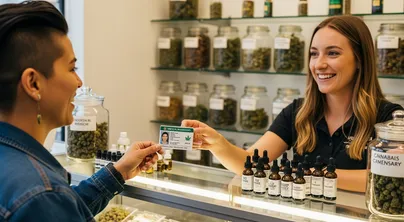
Your written certification lets you buy medical cannabis. Show your Patient ID, certification, and photo ID at any licensed Maryland dispensary. You can make your first purchase the same day you get certified.
Documents to Have Ready for Your Application
Gathering your documents before you start prevents delays and keeps things moving. You need specific items for both your MCA registration and your provider visit.
Required Identification and Residency Proof
You must give a valid government-issued photo ID with your Maryland address, such as a driver’s license or state ID card. If your ID shows an old address, you need more proof of Maryland residency from the last 90 days.
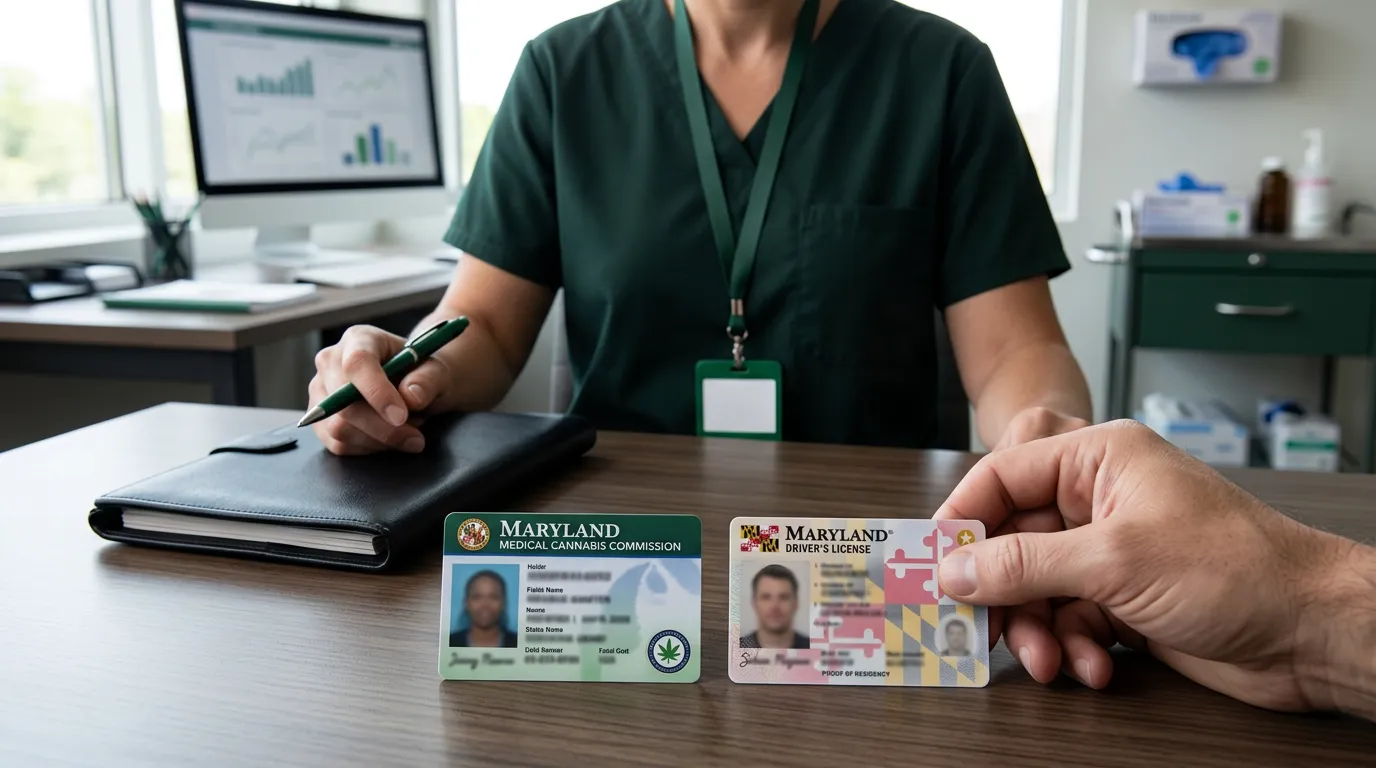
Acceptable residency documents include a utility bill, lease, or bank statement with your current Maryland address. You also need a recent passport-style photo that meets state rules. It must have a plain background and show you facing forward. No hats or sunglasses are allowed. Your face must be clearly visible.
Medical Documentation for Provider Evaluation
Bring medical records or other proof of your health condition to share with your certifying provider. These records help your provider understand your history and decide if cannabis therapy suits you.
Have a payment method ready for your provider visit. Knowing medical card costs and provider fees helps you budget. Keeping your documents organized saves time and helps your application move through each step without a pause.
Timeline: Provider Visit vs State Processing
Knowing the timeline helps you plan when you’ll have access to medical cannabis. The process has two phases: state registration and provider certification.
MCA Patient Registration Timeline
MCA patient registration usually takes 5-7 business days after you submit your application and documents through the online portal. You’ll get your Patient ID number by email once you’re approved.
Processing may take longer during busy periods or if your application needs more review. Check your email often for updates from the Maryland Cannabis Administration.
Provider Certification Timeline
Once you have your Patient ID, you can book a provider visit. Telehealth services often offer same-day or next-day appointments. This is the fastest part of the process.
The visit itself takes 15-30 minutes. If you’re approved, you usually get your written certification right away. This certification lets you buy from dispensaries.
Total Time to First Purchase
After you get your written certification, you can visit a licensed dispensary the same day to make your first purchase. Knowing how medical cannabis cards provide legal protections helps you see why this process matters.
The total time from MCA registration to your first dispensary purchase usually runs 7-14 days. Fast telehealth options can cut this time a lot, sometimes to as little as one week.
Maryland Medical Card Costs and Fees
What You Actually Pay
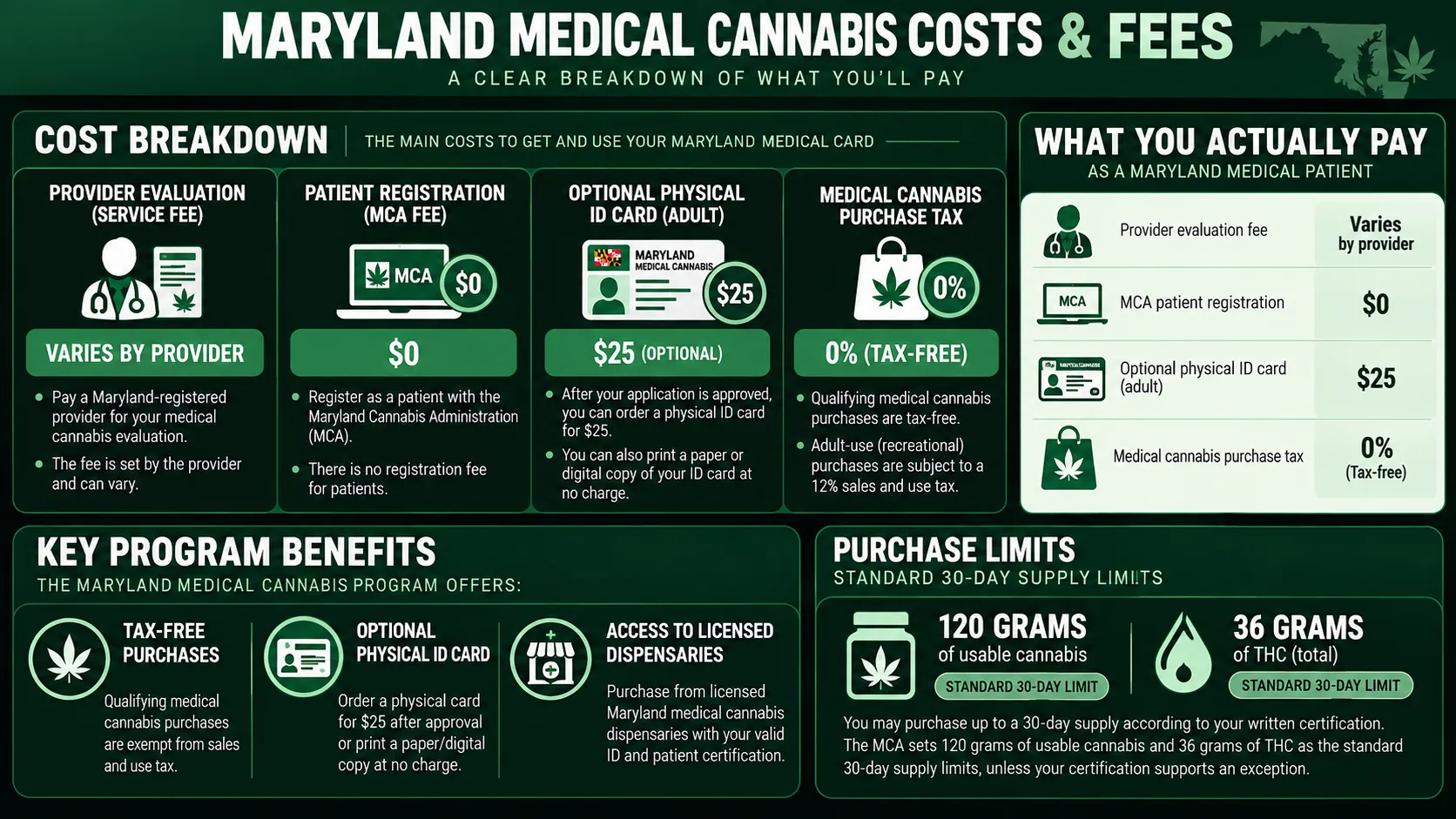
Maryland patient registration through the MCA is currently free. You pay no required state application fee to get your Patient ID.
The main cost is your provider consultation fee. It varies based on whether you choose an in-person or telehealth visit and which service you pick. Telehealth visits usually cost $50 to $200, while in-person visits may cost more.
Annual recertification needs a new provider consultation, but no added MCA registration fee. Budget for this yearly cost when you plan your medical cannabis treatment.
Optional Physical Card Fee
The MCA offers an optional physical card for a fee. You can get one if you want a physical patient ID card instead of just your digital Patient ID number. Check current MCA pricing on the official Maryland Cannabis Administration website for the cost.
Most dispensaries accept your digital Patient ID number with a government-issued photo ID, so you don’t need the physical card to buy. You can use the program fully without paying for it.
Unlike recreational cannabis, medical cannabis in Maryland may offer tax savings and higher potency products not found in the adult-use market. These perks can offset your consultation and optional card costs over time.
Minors and Caregivers in Maryland’s Program
Maryland’s medical cannabis program covers patients under 18, but with extra safeguards to protect young patients.
Requirements for Minor Patients
A minor needs a written certification from an MCA-registered provider. The minor must also have at least one caregiver who is a parent or legal guardian.
A minor must have at least one caregiver who is a parent or legal guardian. Maryland also allows additional caregivers for minor patients under its current program rules. Registered caregivers purchase and transport medical cannabis for the minor.
Caregiver Registration Process
Caregivers complete their own registration through the MCA system after the patient registration is approved. You’ll get a caregiver ID that links to the minor patient’s account.
Maryland allows a registered patient to have up to two caregivers. A caregiver can serve up to five registered patients at one time.
Caregivers aren’t limited to minors. Adult patients who need help getting or giving their medicine can name a caregiver. This applies to those with a disability or other limits. You can name a caregiver through the same registration process.
Buying and Using Medical Cannabis After Approval
How Medical Differs from Adult-Use in Maryland
Maryland runs both medical and adult-use cannabis programs, but your medical card brings added benefits. Medical patients can buy higher potency products that go beyond adult-use limits. They may also get tax benefits and legal protections that recreational users don’t have.
These differences matter when you need steady, effective treatment for your condition. Adult-use products may not give the therapeutic strength your provider recommends.
Making Your First Dispensary Visit
Bring your Patient ID, written certification, and government-issued photo ID to every dispensary visit. Staff will check these documents before you can browse or buy.
Maryland medical dispensaries don’t set per-transaction purchase limits, though your provider may make recommendations. The state tracks all purchases through its monitoring system to make sure you follow the rules.
Dispensary staff can guide you toward the right products for your qualifying condition and experience level. Don’t hesitate to ask about dosing, effects, or product differences.
Product Types Available
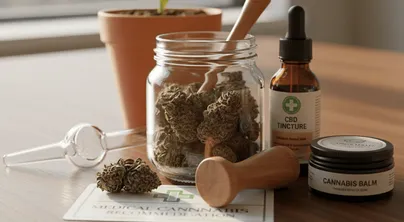
Medical dispensaries stock flower, concentrates, edibles, tinctures, topicals, vape cartridges, and transdermal patches. Medical-grade options often go beyond adult-use potency limits to meet therapeutic needs.
Start with low doses and raise them slowly. Keep a journal of products, doses, and effects to share with your provider at follow-up visits. This record helps refine your treatment plan over time.
Travel, Employment, and Driving Considerations
Your Maryland medical card protects you only within state borders. Knowing these limits helps you avoid legal problems.
Interstate Travel Restrictions
You cannot legally carry cannabis across state lines, even to states with medical programs. Federal law classifies cannabis as illegal.
You cannot bring medical cannabis onto federal property, such as military bases or national parks. Your medical card does not change federal rules.
Workplace Drug Testing Policies
Maryland employers can set drug-free workplace policies and act on positive cannabis tests. Current law does not require workplace accommodation for registered medical patients.
Some employers may be more flexible than others. You have no automatic protection from firing or discipline for cannabis use. This applies even with a valid medical card.
Driving and Impairment Laws
You cannot use or possess medical cannabis while driving. Maryland’s DUI laws apply to cannabis impairment just as they do to alcohol.
Law enforcement can charge you with impaired driving if they decide cannabis has affected your ability to drive safely, regardless of your medical card status.
These are factual descriptions of current Maryland law and federal rules, not legal advice. Consult an attorney for guidance on your situation.
Conclusion
Getting your Maryland medical card means following the right order. Register with the MCA first and get your Patient ID. Then get certified by a licensed provider. Most applicants finish the whole process in 7-14 days, and the MCA registration itself is free. Medical patients gain access to higher potency products and legal protections. Adult-use consumers don’t get these benefits. The program is valuable for those managing chronic health conditions.
Start by gathering your proof of residency and photo ID. Then create your account on the Maryland Cannabis Administration patient portal. Once you get your Patient ID, book a consultation with a registered provider. They can decide whether medical cannabis fits your treatment plan. Keep your medical history records ready to share during your visit.
Ready to begin? LeafyRx connects you with licensed Maryland physicians for convenient online evaluations. This helps you move through certification quickly and start getting the relief you need. Get started today!




 Ask ChatGPT
 Ask Claude
 Ask Perplexity