


Minnesota legalized recreational cannabis in 2027. Yet thousands of residents still apply for a Minnesota Medical Marijuana Card each month. The reason is simple. Medical cardholders get stronger products, lower taxes, and legal protections at work and while traveling. They can also buy larger amounts than recreational users. Despite legalization, many people are still confused. Which conditions qualify? Is a medical card worth the cost? How does the application process work in 2027?
This guide explains who still benefits from a medical card in Minnesota. It walks you through qualifying conditions and the full application process. It also shows you how to use your card at dispensaries. You’ll learn about required documents and fees. You’ll also learn the special rules for minors and caregivers, and what your card lets you do under the law.
Who Needs a Minnesota Medical Marijuana Card in 2027?

Recreational cannabis is legal in Minnesota. Still, a medical card gives patients with qualifying conditions clear advantages. It brings more than simple access. You get savings and legal protections that recreational users don’t have.
Tax Savings and Purchase Limits
Medical cardholders avoid the 10% cannabis excise tax applied to all recreational purchases. For patients using cannabis regularly, this saves hundreds of dollars each year.
Medical patients can buy up to 2.5 ounces of flower per transaction. The recreational limit is 2 ounces. Medical dispensaries also stock higher-potency products that the recreational market restricts. This gives patients stronger options when they need them for symptom relief.
Legal Protections for Employment and Housing
Medical cardholders get stronger legal protections in job and housing disputes. Recreational use can still lead to firing or housing denial. Medical patients have legal standing as registered patients treating qualifying conditions.
Insurance and workplace accommodations differ a lot between medical patients and recreational users. Medical status gives you documentation for reasonable accommodation requests. Recreational users cannot make those requests.
Access to Specialized Medical Products
Medical dispensaries offer consultations with trained staff. Staff give product recommendations for specific conditions. These visits help patients pick the right products, doses, and ways to take them based on their diagnosis and symptoms. It is important to have knowledge about benefits of having a medical card.
Recreational shops focus on general sales. They don’t offer the specialized support found at medical facilities. This matters for patients with complex conditions who need more than basic product information.
How the Minnesota Medical Marijuana Card Program Works
Program Structure and State Oversight
According to the Minnesota Department of Health, the state’s medical cannabis program runs through registered healthcare providers and licensed dispensaries. The program closely oversees every medical cannabis sale and patient registration.
Eight medical dispensaries serve patients across the state. Each stocks products made for medical needs. Staff offer consultations and condition-specific product recommendations.
Medical vs Recreational: Key Differences
Medical patients need a healthcare provider’s certification and must register with the state. Recreational users need only a valid ID. The medical program requires yearly renewal with provider recertification and a state fee.
Medical dispensaries track patient purchases apart from recreational sales limits. This lets medical patients buy stronger products that the recreational market restricts.
Patients who apply online for their medical cannabis card get extra support during the certification process.
Registry System and Card Validity
Registry cards expire after one year. To renew, you need a new provider certification and the renewal fee. The state processes applications within 5-7 business days after it receives both.
According to Minnesota Department of Health oversight, a temporary approval email lets you shop at dispensaries right away while you wait for your physical card. Patients can start treatment without delay once approved.
Minnesota recognizes two categories of qualifying conditions for medical cannabis. Knowing your category tells you which documents you’ll need.
Automatically Qualifying Conditions
Nine conditions qualify automatically with basic medical documentation. Cancer, glaucoma, HIV/AIDS, Tourette syndrome, and ALS receive immediate approval once diagnosed.
Seizure disorders, severe muscle spasms, inflammatory bowel disease, and terminal illness with life expectancy under one year also qualify automatically. Approval rates for cancer and seizure disorders reach 95%.
Conditions Requiring Additional Documentation
Chronic pain, PTSD, autism, and severe pain need more records. You must show a treatment history that proves standard therapies failed or caused harmful side effects.
Mental health conditions like PTSD need a formal diagnosis and treatment history from a licensed mental health professional. Approval rates vary. Chronic pain applications succeed about 70% of the time, while anxiety-related conditions succeed around 60%.
If you’re unsure about your eligibility, you can check if your condition qualifies for medical cannabis before scheduling an evaluation.
Symptom Severity and Medical Record Requirements
Pain conditions need at least six months of recorded symptoms. Your medical records should show past treatments, such as prescription drugs, physical therapy, or other care.
Providers look at how severe your symptoms are, how they affect daily life, and whether you’ve tried other options. Detailed records from your doctors strengthen your application and improve your chances of approval.
How to Apply for a Minnesota Medical Marijuana Card: Step by Step
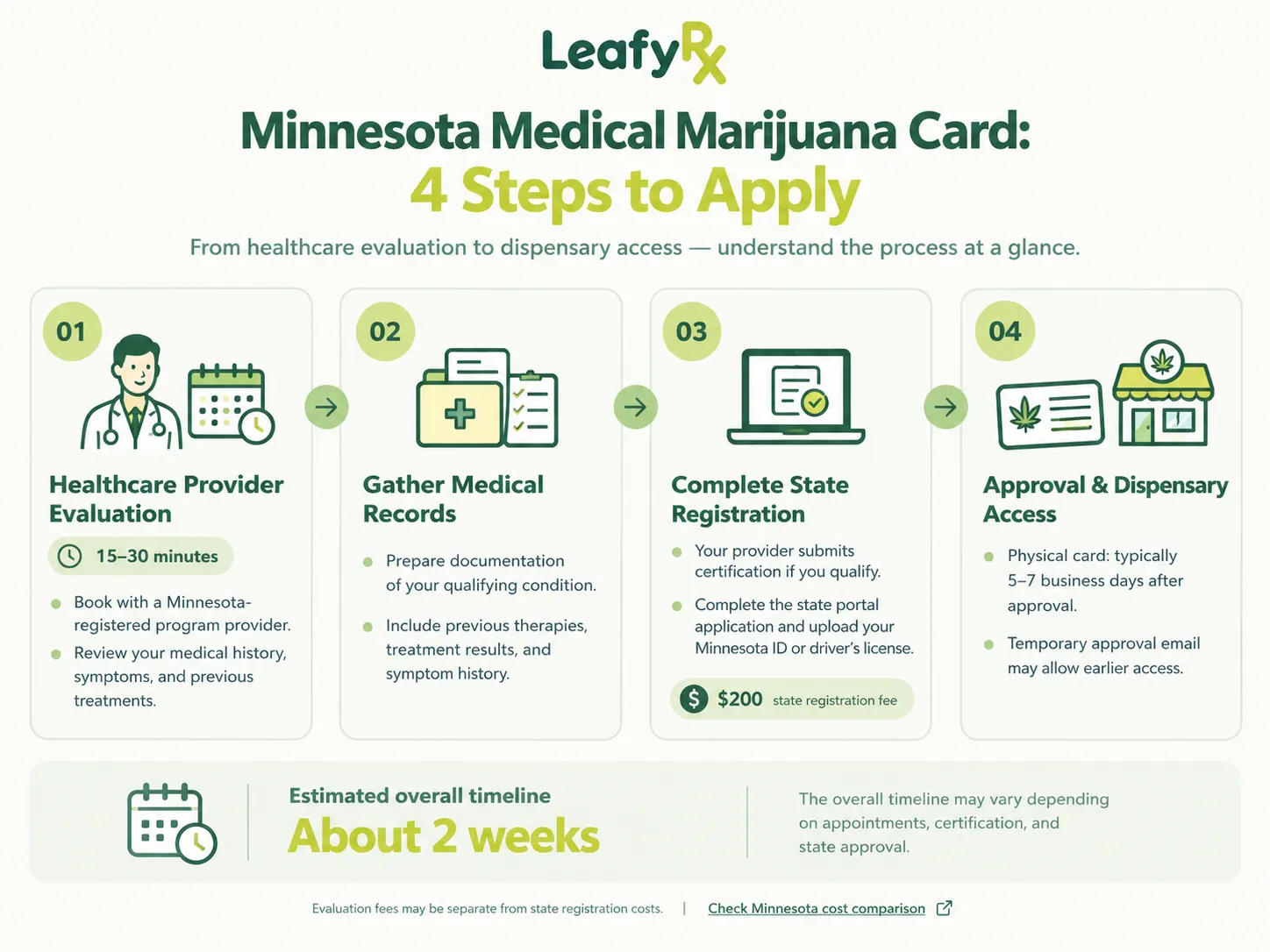
- The application process takes about two weeks from your first appointment to receiving your card. You’ll work with a registered healthcare provider and complete online registration through the state system.
Step 1: Schedule Healthcare Provider Evaluation
Book an appointment with a Minnesota-registered healthcare provider in the medical cannabis program. Not all doctors can certify patients, so check your provider’s registration status first.
The evaluation lasts 15 to 30 minutes. Your provider will review your medical history, current symptoms, and past treatments. Then they will decide whether cannabis is right for your condition.
Step 2: Gather Medical Documentation
Prepare medical records that document your qualifying condition, treatment history, and symptom progression. Bring records showing previous therapies you’ve tried and their results.
This documentation helps your provider make an informed certification decision during your evaluation.
Step 3: Complete State Registration
If you qualify, your provider sends the certification to the Minnesota Department of Health. You’ll get a notice to finish your part of the application on the state portal.
Log into the online system, upload your Minnesota ID or driver’s license, and pay the $200 state registration fee. A state-by-state cost comparison helps you budget for all expenses, including the evaluation fee.
Step 4: Receive Your Card and Access Dispensaries
Your registry card arrives within five to seven business days after approval. You’ll get a temporary approval email that lets you shop at dispensaries right away while you wait for the physical card.
Visit any of Minnesota’s eight medical dispensary locations with your card and valid photo ID to begin purchasing products.
Minnesota Medical Marijuana Card Documents, Timeline, and Fees

Required Documentation Checklist
You need three main documents to complete your application. First, bring a valid Minnesota driver’s license or state ID to prove residency and identity.
Second, gather medical records that show your qualifying condition. These records should document your diagnosis, treatment history, and current symptoms.
Third, if you’re applying for the reduced fee, bring proof of medical assistance enrollment. This proves you qualify for the lower registration cost.
Complete Cost Breakdown
Healthcare provider evaluation fees range from $150 to $300. The cost depends on whether you choose an in-person visit or telehealth appointment.
The state registration fee is $200 annually. Medical assistance recipients pay just $50 with proper documentation.
Your total first-year cost typically runs $350 to $500, including both evaluation and registration. Renewal years cost $150 to $300 for recertification, plus the $200 state fee.
Processing Timeline and Renewal Schedule
According to Minnesota Cannabis Hub, application processing takes 5 to 7 business days after your provider submits certification and you pay the state fee.
You’ll get a temporary approval email that lets you shop at dispensaries right away while you wait for your physical card. Cards expire after one year. To renew, you need new provider certification and the state registration fee.
Minnesota Medical Marijuana Card for Minors and Caregivers
Minor Patient Requirements
Minors under 18 can qualify for medical cannabis in Minnesota, but the process differs from adult applications. Two healthcare providers must certify the minor’s condition. Adults need only one provider.
A parent or legal guardian must serve as the registered caregiver. Minor patients most often qualify for seizure disorders, autism, and cancer-related conditions.
Caregiver Registration Process
Parents or guardians must file a separate caregiver registration. They also pay a $50 caregiver fee on top of the standard registration cost. Caregivers must be Minnesota residents over 21.
A single caregiver can register for up to five patients. The application requires proof of identity, residency, and legal relationship to the minor patient.
Parental Responsibilities and Restrictions
Caregivers make all dispensary purchases for minor patients and control how products are given. The minor cannot visit dispensaries alone or hold cannabis without caregiver supervision.
Parents decide dosing schedules, product types, and storage methods. This setup protects minors and gives them appropriate cannabis treatment under adult oversight.
Using Your Minnesota Medical Marijuana Card: Buying, Travel, Work, and Driving
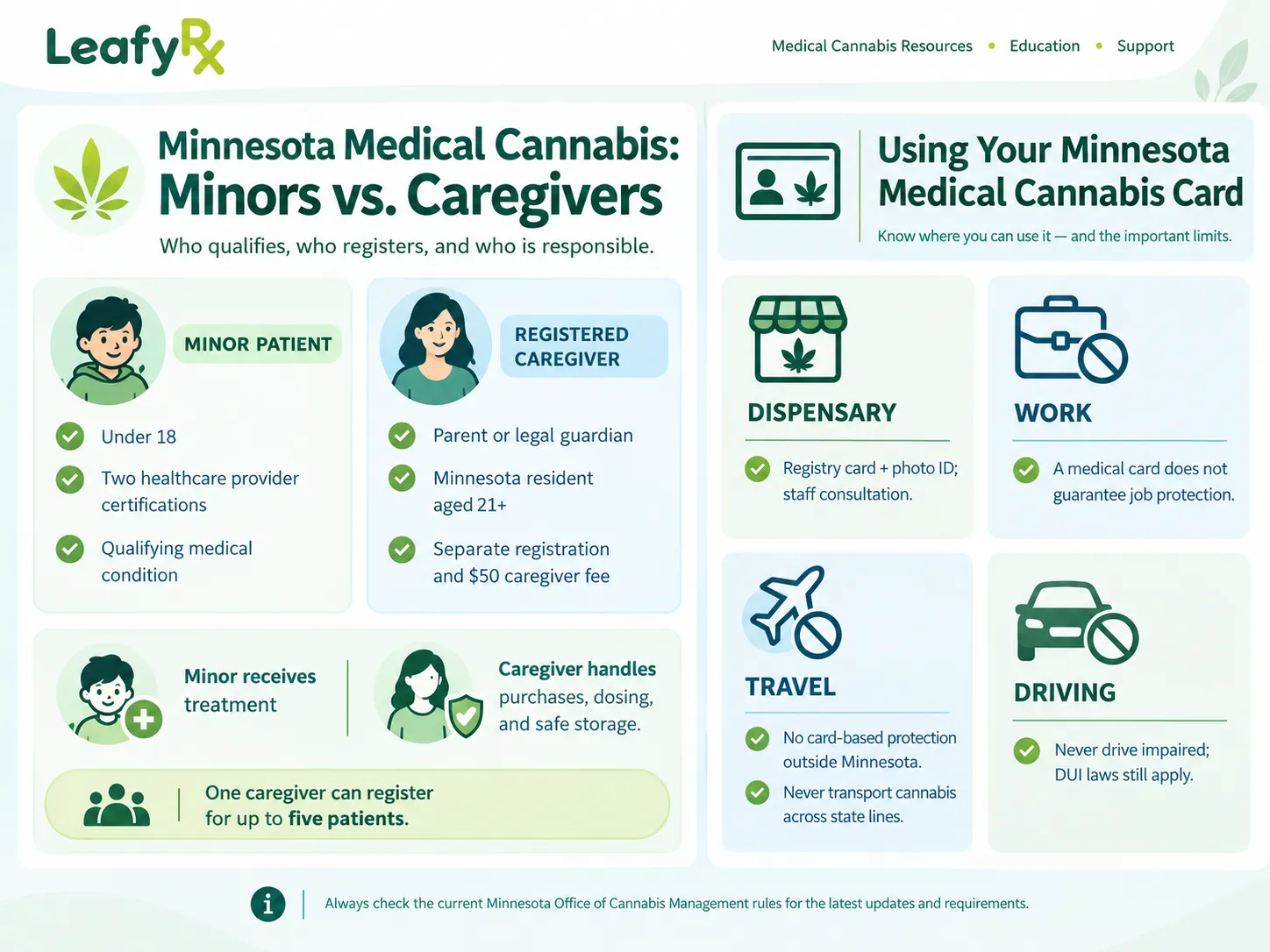
Your registry card gives you access to medical dispensaries and products. It also comes with limits that affect work, travel, and daily life. Knowing these limits helps you use your card legally and avoid problems.
Dispensary Visits and Purchase Process
Minnesota operates 8 medical dispensary locations through licensed manufacturers. Find your nearest location through the state registry website.
Bring your registry card and valid photo ID to the dispensary. Your first visit includes a consultation with trained staff who help you select products based on your specific condition.
Medical patients can purchase up to 2.5 ounces of flower per transaction with no monthly limit. You can also buy equivalent amounts of concentrates, edibles, and tinctures during the same visit.
Workplace Rights and Limitations
Your medical card does not protect you from workplace drug testing or firing in most private jobs. Employers can enforce drug-free workplace policies, even for registered medical patients.
Some protections may apply in specific cases, but they vary by employer and situation. Check your company’s policies before you assume your card protects you at work.
Travel Restrictions and Driving Laws
Your Minnesota card works only within state borders. Agreements with other states ended after recreational legalization. Your card gives no legal protection elsewhere.
Never transport cannabis across state lines, even to states with legal programs. Federal law bans interstate cannabis transport, no matter what state laws say or what Minnesota’s qualifying medical conditions allow.
Driving under the influence of cannabis is still illegal for medical cardholders. DUI laws apply to medical patients too. Your card is no defense against impaired driving charges.
Conclusion
A Minnesota Medical Marijuana Card remains a smart choice for patients who use cannabis regularly to manage qualifying conditions. Tax savings, higher purchase limits, and specialized medical products typically cover the $350-$500 first-year cost. That often happens within a few months of regular use.
If you have chronic pain, PTSD, seizures, or another qualifying condition, start by gathering your medical records. Then schedule an evaluation with a registered healthcare provider. You’ll need documents showing your diagnosis and past treatments. Once certified, you can finish your state registration online and visit medical dispensaries within days.
LeafyRx connects you with licensed Minnesota healthcare providers for fast, affordable telehealth evaluations. Get certified from home, receive approval within days, and start enjoying the benefits of medical cannabis in 2027.






 Ask ChatGPT
 Ask Claude
 Ask Perplexity