


A Texas Medical Marijuana Card gives you legal access to low-THC cannabis products. The state runs this access through its Compassionate Use Program. Texas works differently from most states. You don’t receive a physical card. Instead, you get a physician’s prescription. That prescription enrolls you in a state database, which lets you buy from licensed dispensaries. The program now covers more than 15 qualifying conditions, such as chronic pain, PTSD, and cancer. The application steps are also simpler than in previous years.
This guide explains who qualifies for medical cannabis in Texas. It also shows how to apply, step by step. You’ll learn what the process costs. You’ll also see how caregivers can help minors get treatment. Next, you’ll learn how to use your prescription for purchases and which products are available. The registry system protects your privacy. It also keeps you compliant with state law.
Who Needs a Texas Medical Marijuana Card in 2027?

Texas residents with a qualifying condition need a physician’s prescription to buy legal cannabis. The Compassionate Use Program runs this system. The program serves patients who have tried conventional treatments without success. It also serves patients who want alternatives to medications that can be habit-forming.
Patients with Qualifying Medical Conditions
Anyone diagnosed with one of the 15+ qualifying conditions can ask a registered physician for a prescription. The list includes epilepsy, PTSD, cancer, chronic pain, multiple sclerosis, and autism spectrum disorder.
According to the Marijuana Policy Project, the program has grown a lot since it started. It now covers a much wider range of medical needs. Many patients seeking chronic pain relief look for alternatives to opioid medications. They make up a large share of those who qualify.
When Medical Cannabis Is the Right Treatment Option
Medical cannabis becomes an option when conventional treatments have not provided adequate relief. A valid prescription protects patients from the legal risks of non-medical cannabis use.
Learn about the legal protections and access advantages of prescription cannabis before you decide. To get legal access to low-THC cannabis in Texas, you need a prescription from a registered physician.
Who Cannot Get a Texas Medical Marijuana Card
Patients without a qualifying medical condition cannot get a prescription. Personal preference does not change this. Non-residents of Texas are also ineligible for the program.
Minors with qualifying conditions need parental consent and a registered caregiver before treatment starts. If both parents share legal custody, both must give consent. At least one parent must register as the designated caregiver. That caregiver buys and gives the products.
How the Texas Medical Marijuana Card Program Works
Texas works differently from most medical cannabis states. You won’t get a physical card in the mail. You also won’t carry a wallet-sized card to show at dispensaries.
The Compassionate Use Registry System
According to the Texas official medical marijuana program, the state uses the Compassionate Use Registry (CUR) to track prescriptions and sales. Only doctors listed in the Compassionate Use Registry of Texas (CURT) can prescribe low-THC products.
Products contain no more than 1% THC by weight. CBD content is not restricted. Prescriptions stay valid for 90 days to one year. Your physician decides the exact period.
Many patients use services like LeafyRX to find registered physicians. These doctors evaluate the patient’s condition. They can then enter the prescription into the state system.
Prescription-Based vs. Card-Based Programs
The Texas State Law Library’s guidance on the Compassionate Use Program says Texas uses prescriptions, not physical medical cards. Your physician enters your prescription into the state registry after approval. That digital record is your authorization.
You don’t need to wait for a card to arrive. You also don’t need to worry about renewal reminders. Your Texas driver’s license or state ID, plus your registry entry, is all the verification you need.
How Dispensaries Verify Your Prescription
When you visit a licensed dispensary, staff members check your prescription in the state registry before any sale. You show your valid Texas ID. They then confirm that your prescription is active in the system.
Verification happens in real time. You can buy products right away if your prescription is current. This system also helps dispensaries track purchase limits and report transactions to the state as required by law.
Texas Medical Marijuana Card Qualifying Conditions
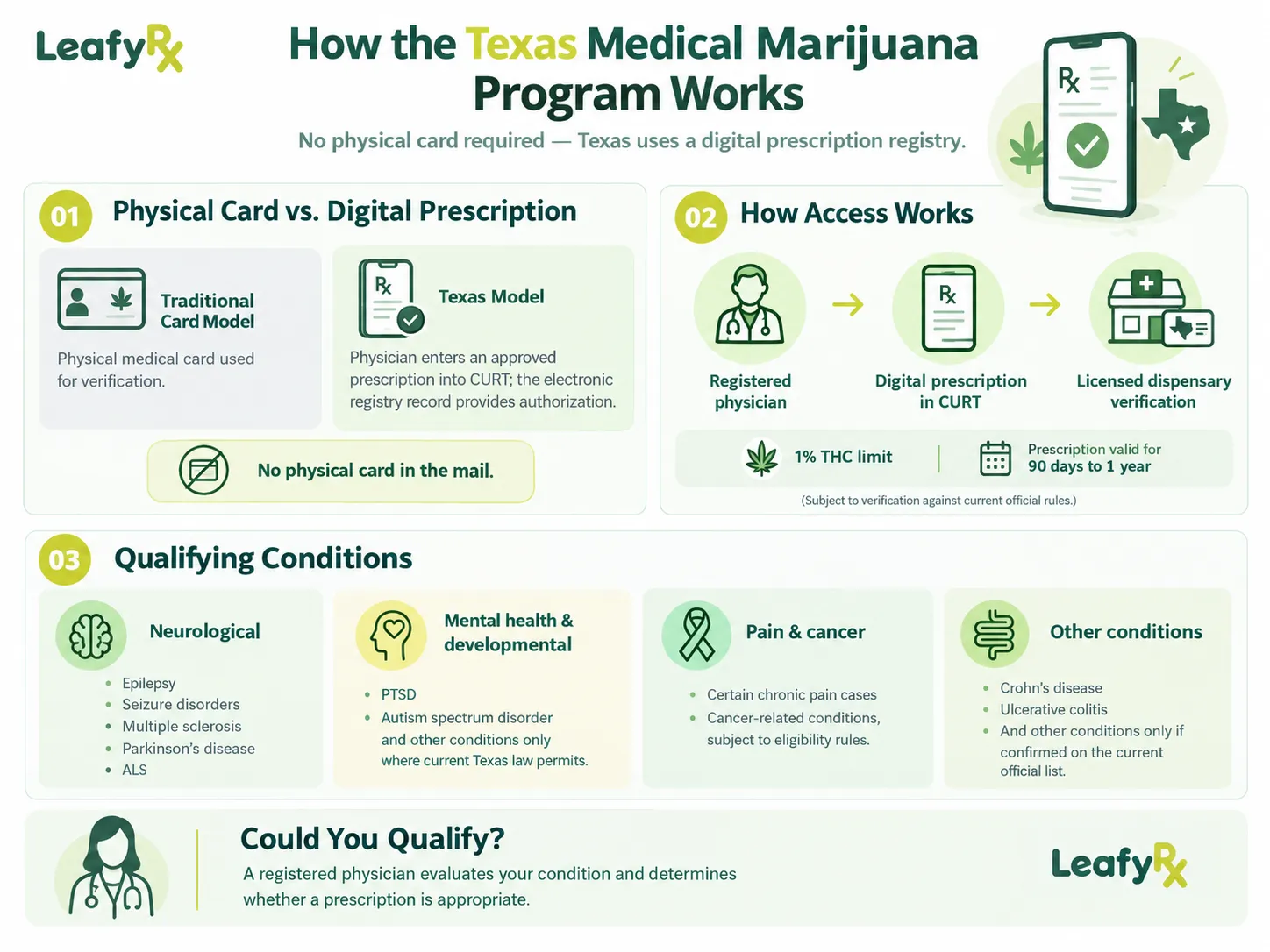
Texas has greatly widened its medical cannabis program since 2027.
The state now recognizes over 15 qualifying conditions, making access available to more patients than ever before.
Neurological and Seizure Disorders
Epilepsy and seizure disorders were the first qualifying conditions. The program launched in 2015. Today, the list includes multiple sclerosis, Parkinson’s disease, ALS, and other neurodegenerative diseases.
Spasticity also qualifies under current rules. These conditions often respond well to low-THC cannabis products available through the program.
Mental Health Conditions
PTSD, anxiety disorders, and autism spectrum disorder now qualify under expanded rules. This change shows growing support for cannabis as a mental health treatment.
LeafyRX connects patients with registered physicians. These doctors know the qualifying conditions and can review your situation. Many patients find relief when conventional treatments haven’t worked.
Chronic Pain and Terminal Illness
Chronic pain conditions that would otherwise require opioid prescriptions qualify for medical cannabis. Cancer patients in active treatment or with terminal diagnoses are also eligible.
This category offers an alternative for patients who want to avoid the risks of long-term opioid use. Check whether your specific condition qualifies for medical cannabis before you apply.
Complete List of Qualifying Conditions
The complete list includes Crohn’s disease, ulcerative colitis, and other inflammatory conditions. As of 2027, Texas recognizes more than 15 specific medical conditions through the Compassionate Use Program.
Each condition requires medical documentation and a diagnosis from a licensed physician. Texas has become more inclusive over time. See how qualifying conditions vary across different state programs. Some limits still apply to THC levels.
How to Apply for a Texas Medical Marijuana Card: Step by Step
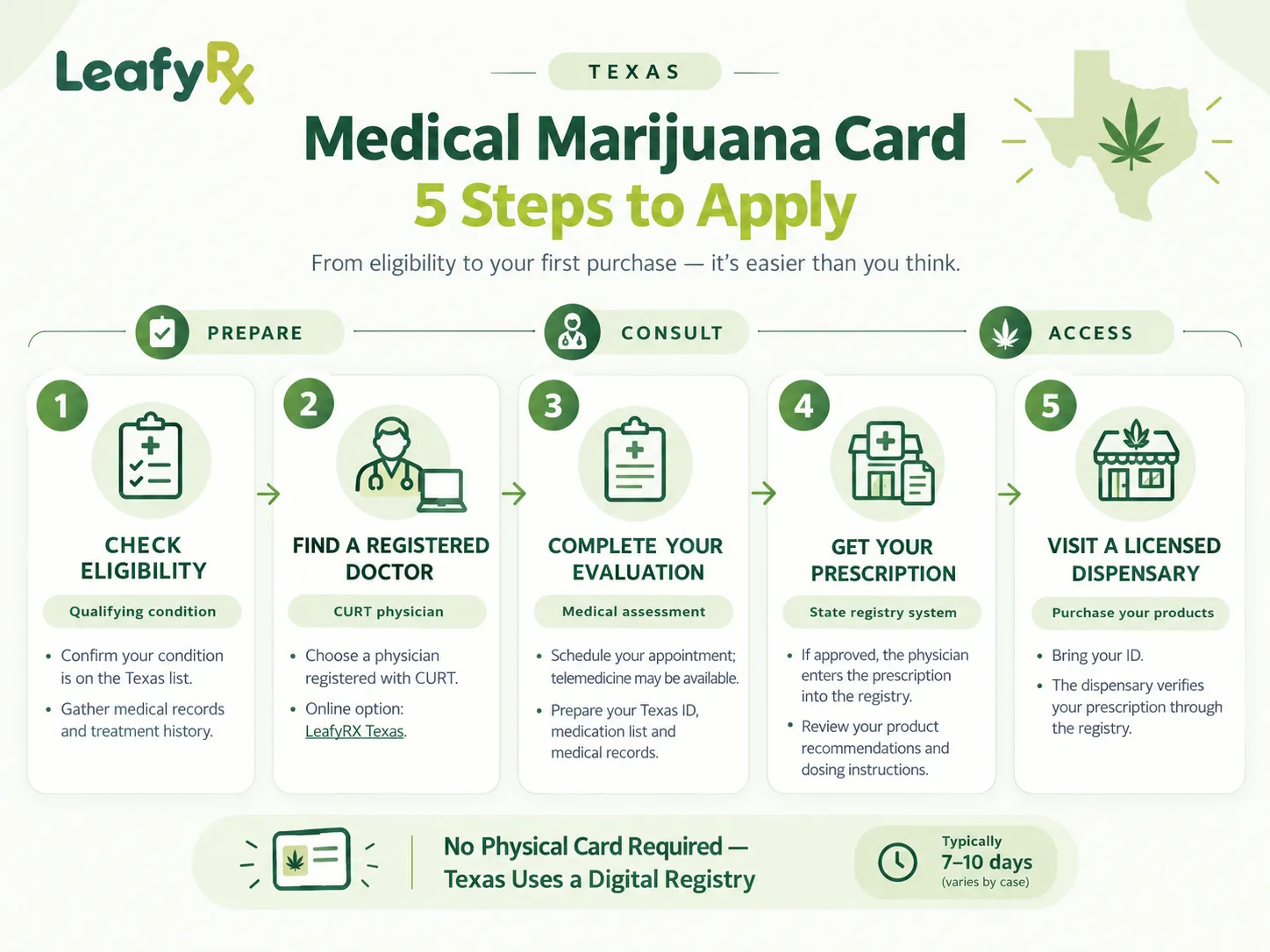
Most patients complete the entire process within 7 to 10 days of initial contact. The state uses a registry system rather than physical cards, which speeds up access once you receive approval.
Step 1: Confirm Your Qualifying Condition
Verify your condition appears on the official qualifying conditions list maintained by the Texas Department of State Health Services. Gather medical records documenting your diagnosis and treatment history, as physicians need this information to confirm eligibility.
Step 2: Find a Registered CURT Physician
Search for physicians registered with the Compassionate Use Registry of Texas (CURT). Only these doctors can legally prescribe low-THC cannabis products in the state. You can apply online through telemedicine platforms that connect you with registered physicians.
Step 3: Schedule Your Evaluation
Schedule an evaluation appointment with your chosen physician. Telemedicine is permitted for most conditions, making the process more convenient.
Attend your evaluation with complete medical documentation and valid Texas ID. Bring your current medication list and details about previous treatments you’ve tried.
Step 4: Receive Your Prescription
The physician enters your prescription directly into the state registry system if you’re approved. You’ll receive prescription details including product recommendations and dosing instructions during or immediately after your appointment.
Step 5: Visit a Licensed Dispensary
Visit any licensed Texas dispensary with your ID to purchase products. The dispensary verifies your prescription through the state registry before completing the sale.
Texas Medical Marijuana Card Documents, Timeline, and Fees
Preparing for your medical cannabis evaluation requires gathering specific documentation. You’ll need a valid Texas driver’s license or state-issued ID to prove residency, along with medical records that document your qualifying condition and treatment history. Bring a list of current medications and previous treatments you’ve tried.
Required Documents for Your Evaluation
Your physician will review your complete medical history during the evaluation. Most doctors require records spanning at least the past year, showing diagnosis dates and treatment attempts. If you’re seeking cannabis for chronic pain, bring documentation of any opioid prescriptions or alternative pain management approaches you’ve used.
Application Timeline and Processing
Most patients complete their evaluation within one to three days of scheduling. If approved, your physician enters the prescription directly into the state registry immediately. You can visit a dispensary the same day with your Texas ID.
The entire process typically takes seven to ten days from initial contact to product purchase. No waiting period exists once your prescription enters the registry.
Physician Fees and Product Costs
Initial physician evaluations cost $150 to $300, depending on the provider and consultation complexity. Follow-up appointments for prescription renewals run $100 to $200. Texas doesn’t charge a state application fee since no physical card is issued.
Dispensary products range from $60 to $150 per bottle for tinctures. Insurance plans don’t cover medical cannabis products or evaluations. Most patients spend $800 to $2,000 during their first year, including the evaluation and several months of products.
Texas Medical Marijuana Card for Minors and Caregivers

Minors under 18 can access medical cannabis in Texas, but the process requires additional steps and oversight. Parents or legal guardians play a direct role in every aspect of treatment.
Qualifying Conditions for Minors
Epilepsy, autism spectrum disorder, and terminal cancer are the most common qualifying conditions for pediatric patients. According to the patient guide to TCUP eligibility, physicians may require additional documentation when evaluating minors to confirm the diagnosis and treatment history.
Children with seizure disorders that haven’t responded to conventional medications often qualify. The same applies to autism patients experiencing severe behavioral symptoms.
Caregiver Registration Requirements
At least one parent or legal guardian must register as the designated caregiver for any minor patient. Caregivers must be Texas residents with valid state identification.
The caregiver purchases and administers all medical cannabis products on behalf of the minor. A single caregiver can manage prescriptions for multiple patients if approved by the physician and registry system.
Parental Consent and Legal Guardian Rules
Both parents must consent if they share legal custody of the minor patient. This requirement protects the rights of both custodial parents in medical decisions.
Courts recognize that medical cannabis treatment involves ongoing decisions about dosing and product selection. Physicians verify custody arrangements before issuing prescriptions to avoid legal complications.
Conclusion
Getting a Texas Medical Marijuana Card in 2027 means working with a CURT-registered physician. They can evaluate your condition and enter your prescription into the state registry. The process is straightforward for patients with qualifying conditions, and most people receive approval within days of their evaluation appointment.
If you have a qualifying medical condition, your next step is finding a registered physician who can evaluate your specific situation. Gather your medical records, verify your condition qualifies under current Texas law, and schedule an evaluation. Telemedicine appointments make the process convenient, and you can usually complete everything from home.
LeafyRX connects you with licensed Texas physicians who specialize in medical cannabis evaluations.Start your evaluation today For Texas to determine if medical marijuana is right for your treatment plan and get legal access to cannabis products at licensed dispensaries.






 Ask ChatGPT
 Ask Claude
 Ask Perplexity